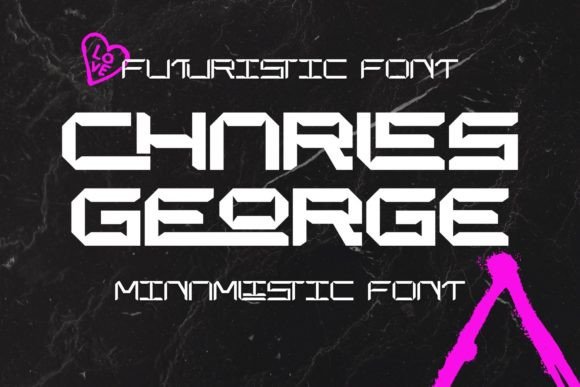
Charles George: A Futuristic Display Font for Crafters
If you’ve ever spent hours tweaking a label design only to realize the typeface feels flat or forgettable—meet Charles George. This isn’t just another sleek display font. It’s a sharp, confident, and unmistakably modern typeface built for makers who sell real things: hand-poured candles, boutique stationery, laser-cut signs, printable planners, SVG cut files, and limited-run apparel. As someone who designs physical products daily—from wedding welcome boards to seasonal sticker packs—I reached for Charles George the moment I saw its clean geometry and subtle cyberpunk edge. And it delivered every time.
Charles George lives firmly in the display font category—and that matters. It’s not meant for body text or long paragraphs. Instead, it shines where impact is non-negotiable: product names on apothecary labels, bold headlines on digital printables, engraved titles on wooden coasters, or crisp vinyl cuts for tote bags. Its letterforms balance futuristic precision with organic rhythm—think tight spacing, angled terminals, and just enough visual tension to feel alive without sacrificing legibility. Even at small sizes (8–12 pt), uppercase words like “LIMITED EDITION” or “SMOKE & SAGE” stay crisp and readable on printed tags or Cricut-cut stickers.
I’ve used Charles George across six distinct craft categories—with consistently strong results:
- Candle & Soap Labels: Paired with a soft sans serif for ingredients, Charles George as the scent name (“NEON RAIN”, “CYBER LAVENDER”) instantly signals premium, intentional design—not generic mass production.
- Wedding Stationery: On acrylic welcome signs or foil-stamped menus, it adds contemporary elegance without coldness. Try it for “Mr. & Mrs.” or table numbers—it reads clearly from six feet away.
- Digital Printables: In planner covers, habit trackers, or wall art PDFs, Charles George gives instant visual hierarchy. Customers notice the difference in perceived quality before they even open the file.
- Svg Cut Files: Its clean outlines cut beautifully on Silhouette Cameo and Cricut Maker machines—even intricate letters like “R” and “G” hold shape at 1.5" height.
- Product Packaging: For small-batch skincare or gourmet spice blends, it conveys innovation and care. No more defaulting to overused tech fonts that blend in.
- Seasonal Crafts: Halloween mugs, retro-futuristic holiday cards, or summer festival merch all gain personality when Charles George anchors the headline.
Readability is where many futuristic fonts stumble—but Charles George avoids common pitfalls. Its x-height is generous, counters are open, and stroke contrast stays moderate. That means it works on matte paper, kraft tags, and glossy stickers alike. For small-format uses—like 0.75" round stickers or mini gift tags—I recommend using all caps with minimal tracking. Avoid stretching or condensing the font; let its natural proportions do the work. And always preview your mockup at 100% scale before sending to print—what looks cool at 200% zoom often blurs when scaled down.
Font pairing is where Charles George truly unlocks versatility. I keep two go-to combos in my design toolkit:
- A warm, relaxed script font (like a gentle brush script or elegant connected handwriting) for subheadings or personal messages—e.g., “Charles George” as the brand name, paired with “Hand-poured in Portland” in script beneath.
- A neutral, highly legible sans serif font (think Montserrat, Inter, or Work Sans) for supporting text—ingredients, dates, care instructions, or QR code labels. The contrast creates visual breathing room and guides the eye exactly where you want it.
What’s included matters—especially when you’re building templates or client deliverables. Charles George comes with standard OpenType features: stylistic alternates for letters like “a”, “g”, and “y”, plus ligatures that smooth out awkward letter collisions (try “ff”, “fi”, or “fl”). All files are provided in OTF and WOFF formats—so whether you’re embedding in Canva, loading into Cricut Design Space, or prepping a Shopify banner, compatibility isn’t a hurdle. While it doesn’t include extended Latin or Cyrillic glyphs, it fully supports English, Spanish, French, German, and Portuguese accented characters—enough for most Etsy shop listings, bilingual packaging, and international printable markets.
Let’s talk licensing—because this is where many crafters get tripped up. Yes, Charles George is a commercial font, and yes, you *can* use it to create and sell physical products (candles, shirts, mugs), digital downloads (PDF planners, SVG bundles), and client work (custom invitations, shop branding). But you *cannot* resell the font file itself—or embed it in editable Canva templates where buyers could extract and reuse it. Always check the license terms before bundling it into a template pack or offering layered PSD files. When in doubt, reach out to the foundry. Most reputable creators respond quickly—and clarity here protects your shop, your reputation, and your creative freedom.
What makes Charles George different from other “tech-inspired” display fonts? It doesn’t shout. It doesn’t rely on gimmicks like excessive distortion or forced glitch effects. Instead, it earns attention through intelligent structure—tight kerning, consistent weight distribution, and subtle asymmetry that feels human-made, not algorithm-generated. That’s why customers pause longer on your product page. Why your Etsy listing gets saved more often. Why repeat buyers recognize your brand across candle labels, Instagram stories, and printable wall art—all tied together by one cohesive, forward-looking voice.
Whether you're launching your first craft line or refining a five-year-old shop’s visual identity, Charles George isn’t just another design asset. It’s a quiet upgrade—one that strengthens your brand identity, lifts the perceived value of your handmade goods, and makes your everyday design work feel more intentional, more professional, and more uniquely yours.